
How a business workflow becomes a dependable AI system.

Map the real operation, define where AI belongs, test the risky cases, and increase responsibility only when the evidence supports it.

Workflow input

Work arrives through email, forms, or CRM

The team checks several tools for context

A person decides what should happen next

The handoff is tracked manually

Reply

Fit recommendation + practical next step

What separates a demo from an operating system.

Each stage answers a different question before the workflow takes on more responsibility.

Understand

Audit the real operation

Remote working sessions and real examples expose inputs, handoffs, owners, delays, and exceptions.

Output: Current operating map

Set the decision boundary

Rules stay deterministic, AI gets defined judgment tasks, and sensitive commitments remain with people.

Output: Responsibility map
Prove

Build the usable release

The workflow, integrations, interface, permissions, queues, and status logic are implemented around the work.

Output: Working release

Evaluate realistic cases

Normal inputs, edge conditions, weak data, and failure paths define acceptable output and escalation.

Output: Evaluation baseline

Operate

Establish the operating baseline

Release with named ownership, run history, alerts, fallback, documentation, and recovery procedures.

Output: Production baseline

Improve from evidence

Review accepted outputs, edits, failures, latency, and cost to prioritize the next release.

Output: Improvement backlog

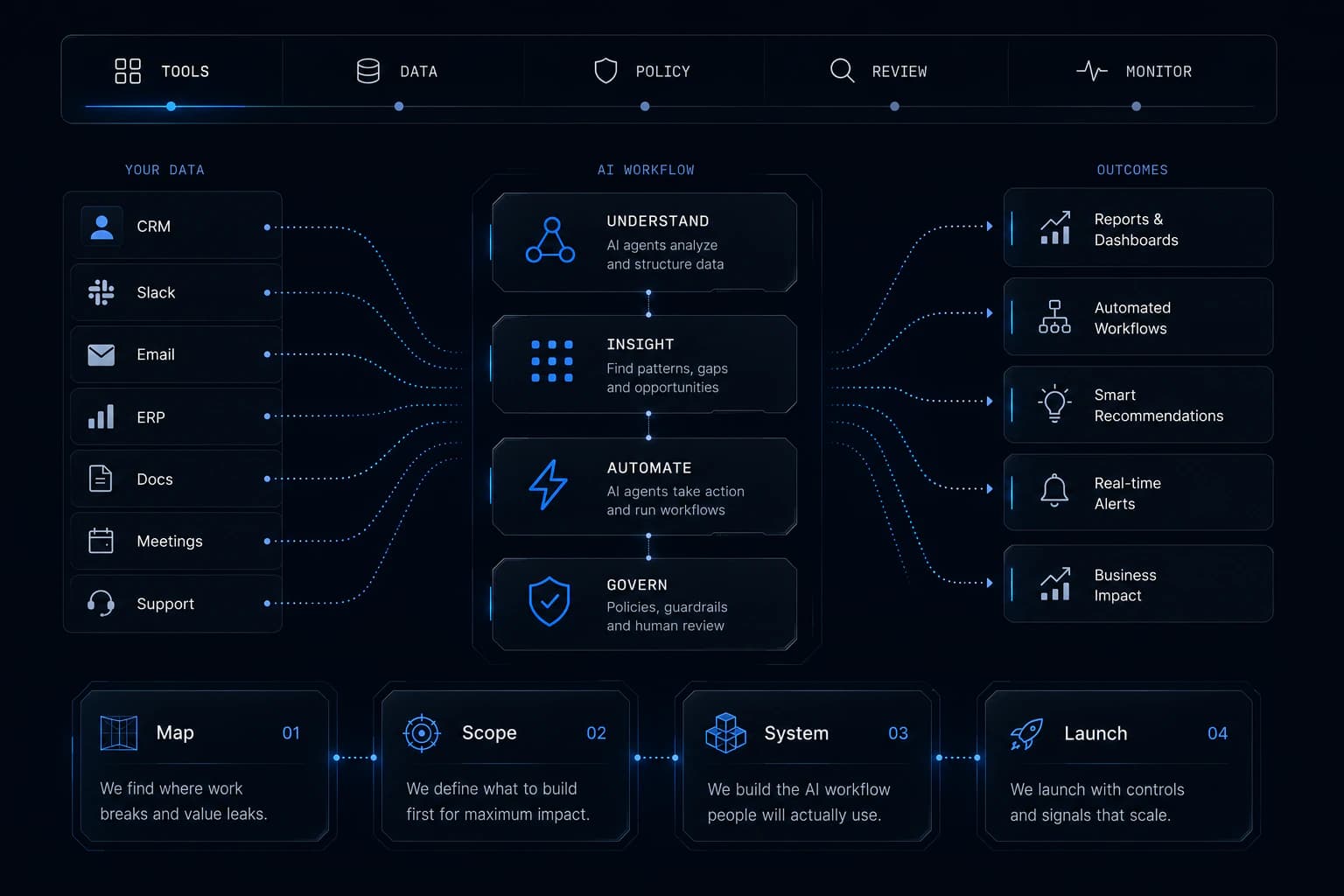
The model is only one part of the system.

Reliable operation also depends on connected tools, allowed data, policy, review, and monitoring.

Business tools and data flowing through an AI workflow with policy, human review, and monitoring

Evaluation set

Production-style cases

Ready for review

Representative case

Incomplete input

Low-confidence output

Provider or tool failure

The difficult cases decide if the workflow is ready.

A successful happy path is not enough. Evaluation makes acceptable behavior, uncertainty, and recovery visible before launch.

Acceptance

What a useful output must contain before it can move on.

Escalation

Which cases need a person, more context, or a safe stop.

Traceability

What is recorded so the team can review and improve behavior.

Responsibility expands in stages.

The system starts where mistakes are easy to inspect and reverse. Wider action is earned through stable results, visible exceptions, and a team that is ready to own the workflow.

  1. Sandbox

    Historical or synthetic inputs prove the workflow shape.

  2. Review first

    People approve every output before it reaches the operation.

  3. Limited action

    Approved low-risk steps run inside explicit boundaries.

  4. Broader operation

    Responsibility expands only where production evidence is strong.

Each engagement ends with something your team can use.

The output changes with the scope, but ownership never depends on a presentation or a verbal recommendation.

After the audit

A decision package

Current operating map, decision boundaries, deployment priority, and an evaluation approach.

After the build

A working release

The workflow, interface, integrations, permissions, review points, and real test inputs.

At production handoff

An owned operating system

Run history, fallback behavior, monitoring, documentation, and clear responsibility after launch.

Ready to decide what the first safe release should be?

Send the current workflow for a free fit recommendation, or book a short call if the scope is easier to explain live.